Your profession,
your laws,
your references
Jacquard takes them into account to improve your processes. A sovereign AI, served in Switzerland, with a layer of professional knowledge. You describe the need, it delivers a ready-to-use document.
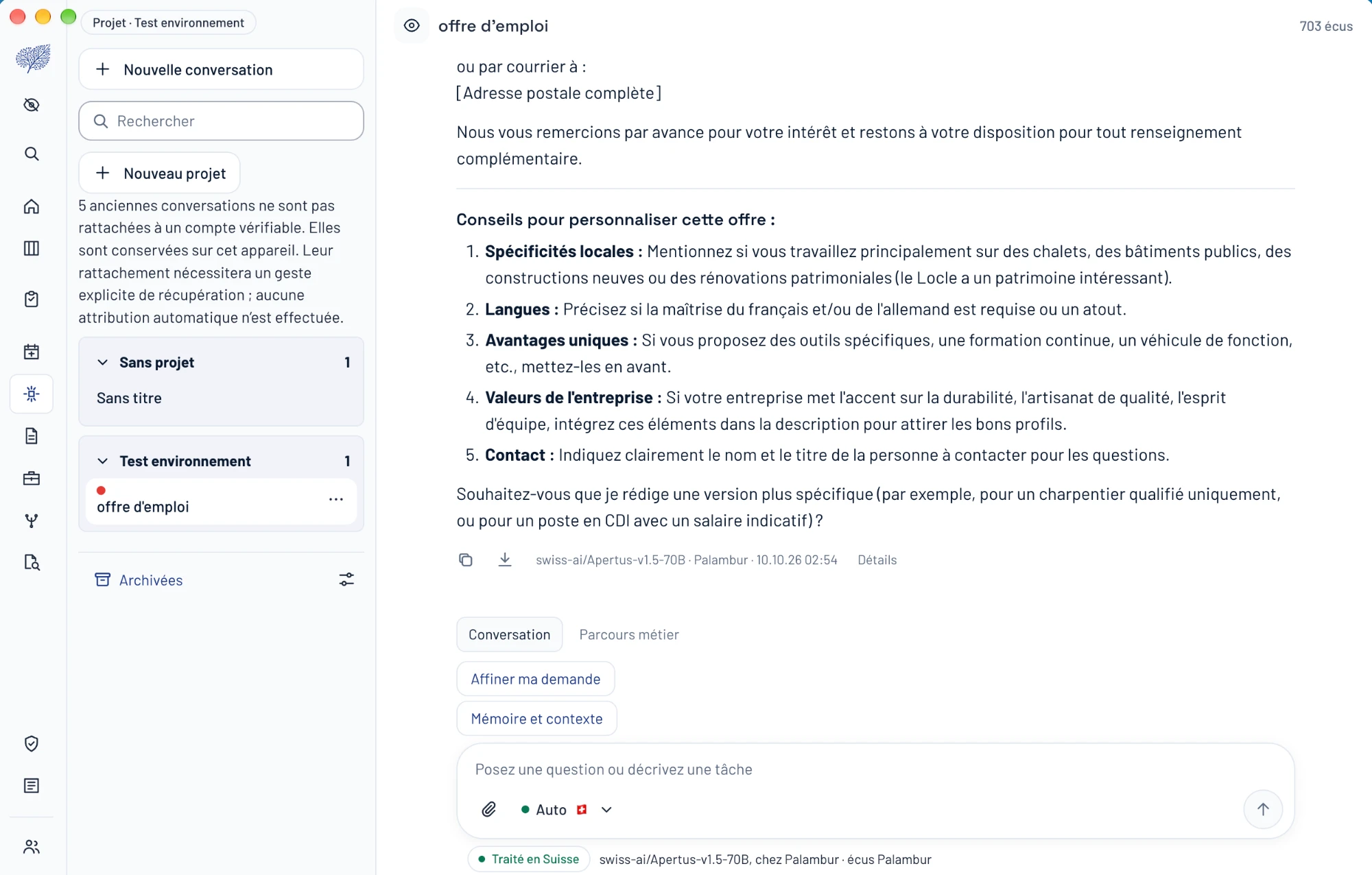
A complete suite of AI tools, sovereign and Swiss.
The Palambur app gives you access to Jacquard and the other tools, interconnected: what one produces feeds the next.
- All your tools in one place, connected to each other
- Projects to organize conversations and files, with search and archives
- Adjustable context: you decide what Jacquard keeps in mind
- A memory of your instructions and your profession, from one conversation to the next
- Your choice of model, with its country’s flag and the “Processed in Switzerland” label
- Live cost in écus, before and during the work
- Guided professional paths and “Refine my request” to clarify a barely formed need
- Every answer can be copied or downloaded in one gesture
A trustworthy AI, that knows what you are talking about.
Sovereign
A Swiss model, served in Switzerland by Infomaniak. With it, your requests stay in Switzerland.
Professional
Over 750 professional tasks, the laws of your country and references, built into every answer.
Useful from day one
You describe, it proposes a plan, then delivers a ready-to-use document.
You stay in control, it does the work.
Nothing happens without your approval.
- A plan and a cost announced before any action
- Access granted folder by folder, by you alone
- It asks you for what is missing rather than inventing it
- A simple account with an e-mail address, no card
Your data, under your control
The Apertus model is served in Switzerland by Infomaniak. Prefer another model? Its country’s flag is shown before you send. In the app, your conversations stay on your computer. Online, they are deleted after 30 days without activity.
Frequently asked questions
How does Jacquard differ from a chat window?
A chat window answers a question. Jacquard knows your profession, frames the need, proposes a plan and delivers a ready-to-use document.
How do I use it?
Online, for a simple conversation with nothing to install. In the app, for an assistant that works on your files. Both open soon: create your account to be notified.
Are my files read without my knowing?
No. Jacquard only reads the folders you authorize, and asks you before entering them.
Do I have to pay to try it?
No. The first document costs nothing and no card is requested. Nothing renews without you.
Create your account before launch.
No card is requested. Nothing renews without you.